
December 20, 2025
🔹 Introduction
Plastic welding is no longer a niche fabrication technique — it’s a cornerstone of modern engineering. From pipelines and automotive assemblies to aerospace interiors and marine tanks, thermoplastic welding ensures durable, leak-proof, and lightweight joints.
As a licensed DVGW 330 & 331 expert (SKZ) with 18 years of hands-on experience, I’ll walk you through the methods, standards, and applications of plastic welding, combining industry codes with practical insights.
🔹 What Is Plastic Welding?
Plastic welding joins thermoplastic materials by heating them to their softening point and consolidating under pressure. Unlike adhesives or fasteners, welding creates a molecular bond that is permanent and resistant to chemicals, stress, and environmental exposure.
Commonly welded materials: ABS, PC, PE, PET, PMMA, PP, PVC.
🔹 3 Steps of Welding Plastics
- Preparation: Clean surfaces, align parts, ensure ventilation and PPE.
- Heating: Apply controlled heat via butt fusion, hot gas, ultrasonic vibration, laser, or friction.
- Joining & Cooling: Apply pressure, allow solidification, finish with sanding or polishing.
🔹 8 Methods of Plastic Welding
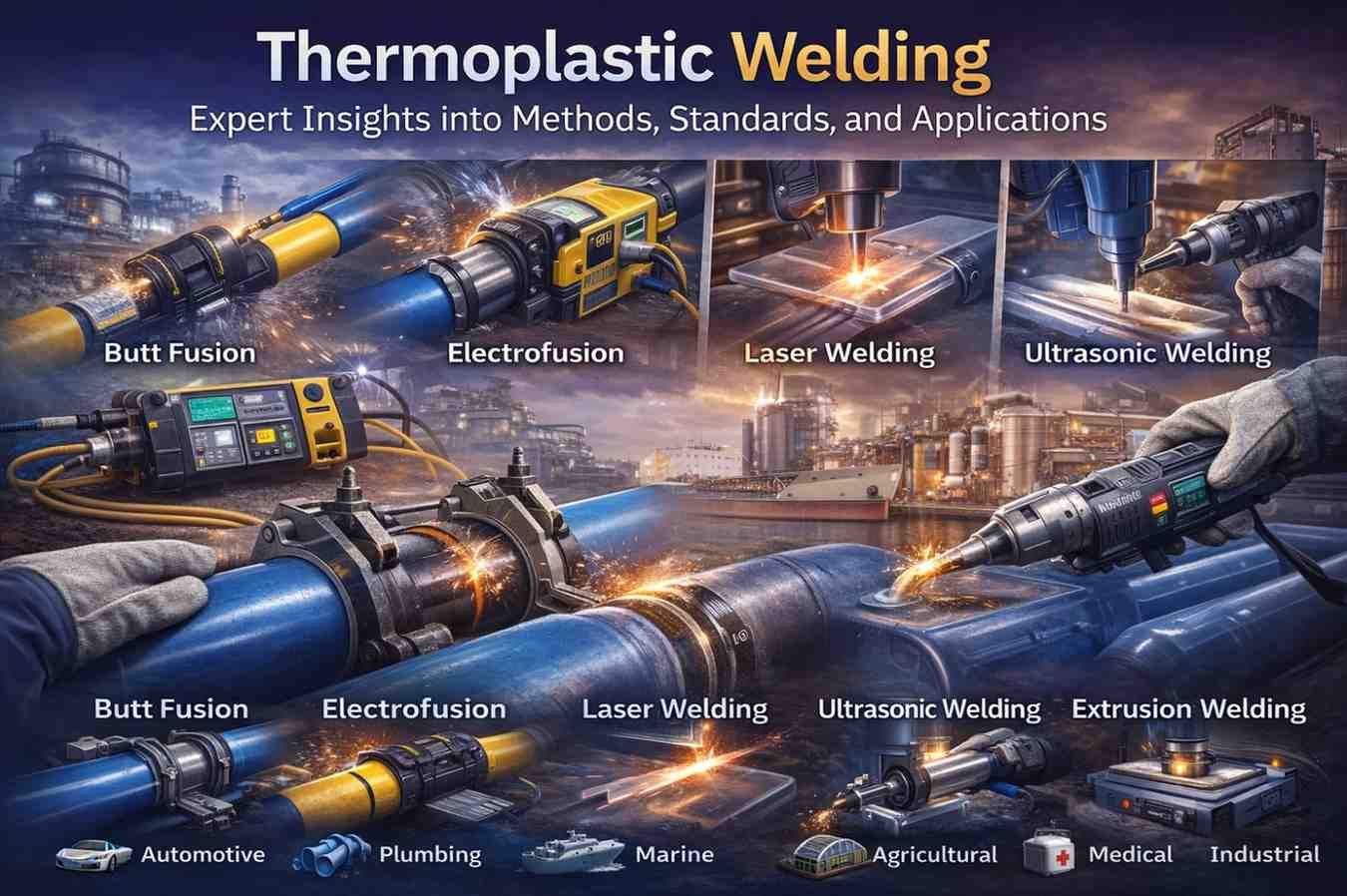
- Butt Fusion: Pipes aligned and fused under heat/pressure.
- Electrofusion: Electric current activates embedded resistors in fittings.
- Extrusion Welding: Molten plastic extruded into seams for tanks/panels.
- Hot Gas Welding: Heated gas softens surfaces for bonding.
- Ultrasonic Welding: High-frequency vibration generates frictional heat.
- Laser Welding: Concentrated beam creates clean, precise welds.
- Spin Welding: Rotational friction joins axisymmetric parts.
- Hot Plate Welding: Heated platen melts surfaces for hermetic bonds.
🔹 Advantages of Plastic Welding
- Permanent, molecular-level joints
- Lightweight assemblies
- Cost-effective (no consumables)
- Versatile across shapes and sizes
- Safer than many metal welding processes
🔹 Applications of Plastic Welded Parts
- Automotive: Mirror cases, bumpers, radiators, battery cases
- Aerospace: interior panels, trays, tanks
- Marine: ballast tanks, fish wells, water tanks
- Agriculture: PVC fencing, misting lines, tanks
- Plumbing: DWV pipes, drains, faucets
- Medical: sterile housings, fluid containers
🔹 Tolerances & Standards
- Bead size & alignment: Controlled per DVGW 330/331.
- Temperature windows: Strictly within polymer melt ranges.
- Dimensional control: Account for shrinkage/expansion.
- QA/QC: Visual inspection, destructive testing, leak/pressure tests.
🔹 CAD-CAM Integration
- Design for weldability (energy directors, transmissive layers).
- Simulate stress tolerances and weld paths digitally.
- Automated logging for certification and traceability.
🔹 Machine Components
- Butt fusion machines: clamps, facing tools, heated plates.
- Electrofusion systems: power controllers, barcode fittings.
- Extrusion guns: screw/barrel heaters, rods matched to base polymer.
- Hot gas welders: portable guns with speed tips.
- Ultrasonic/laser systems: tuned horns, optics, robotic automation.
🔹 Safety
- PPE: gloves, goggles, respirators for PVC.
- Ventilation: local exhaust for fume-prone plastics.
- Electrical/thermal safety: lockout procedures, stable clamping.
- Compliance: EN 13067 personnel qualification, DVGW standards.
🔹 Wrapping It Up
Plastic welding — whether butt fusion, electrofusion, extrusion, ultrasonic, laser, spin, or hot gas — is a discipline that blends engineering precision with material science. With DVGW-certified practices, strict tolerances, CAD-CAM integration, and safety protocols, it delivers lightweight, durable, and cost-effective solutions across industries.
🔹 Call to Action
Looking to create your plastic parts with certified quality? Partner with experts who understand standards, tolerances, and fabrication methods. Upload your CAD files for instant analysis, or consult with licensed engineers to ensure your project meets DVGW 330 & 331 compliance.