
December 20, 2025
🔹 Introduction
With 18 years of hands-on expertise in advanced composites manufacturing, certified by ABARIS Training and trained under Renaissance Aeronautics Associates Inc. (RAAi), I’ve seen how fiberglass and carbon fiber have transformed industries. From aerospace fuselages to marine hulls, composites are redefining strength, weight, and durability.
In today’s world, advanced composites are not just materials — they are systems engineered for performance. They are designed to be lighter, stronger, and longer-lasting, enabling industries to push boundaries in safety, efficiency, and sustainability.
🔹 Why Advanced Composites?
- Lighter: High strength-to-weight ratios reduce fuel consumption in aerospace and automotive, and enable longer wind turbine blades.
- Stronger: Tailored fiber orientations and resin systems deliver superior stiffness, fatigue resistance, and impact tolerance.
- Longer: Corrosion resistance, UV stability, and fatigue endurance extend service life in marine and civil infrastructure.
🔹 Core Components of Composite Systems
Fiber Reinforcements
- Carbon Fiber: Exceptional stiffness and fatigue resistance; used in aerospace primaries and automotive monocoques.
- Fiberglass (E-/S-glass): Affordable, impact-tolerant, corrosion-resistant; dominant in marine and wind energy.
- Aramid (Kevlar): High toughness and impact resistance; ballistic and protective applications.
Matrix Materials (Resin Systems)
- Epoxy: Aerospace-grade, low shrinkage, high fatigue resistance.
- Vinyl Ester: Chemical resistance for marine and tanks.
- Polyester: Economical, widely used in construction and marine.
- Thermoplastics (PEEK, PPS): Recyclable, high-temperature performance.
Core Materials
- Foam (PVC, PMI): Lightweight stiffness for blades and panels.
- Honeycomb (Nomex, aluminum): High stiffness-to-weight for aerospace interiors.
- Balsa: Natural, high compressive strength; used in wind blades and marine.
🔹 Manufacturing Processes
- Resin Infusion (VARTM): Large-scale panels and blades; uniform resin distribution reduces voids.
- Prepreg & Autoclave: Aerospace-grade laminates; precise fiber volume fraction and minimal void content.
- Filament Winding: Cylindrical structures like tanks and pipes.
- Hand Layup: Flexible, low-volume production and repairs.
- Additive Manufacturing (Recent Advancement): Complex geometries with reduced waste.
🔹 Curing & Post Processing
- Curing: Heat and pressure harden resin; autoclave curing achieves aerospace-grade performance.
- Post Processing: Trimming, drilling, sanding, painting; ensures dimensional accuracy and surface finish.
🔹 Composite Assemblies
- Adhesive Bonding: Lightweight, strong, ideal for aerospace and automotive.
- Mechanical Fastening: Hybrid joints with inserts for load transfer.
- Hybrid Assemblies: Combining composites with metals for optimized performance.
🔹 Designing & Engineering Composite Structures
- Finite Element Analysis (FEA): Predict laminate behavior under loads.
- Failure Criteria: Tsai-Wu, Hashin, Puck models for safety margins.
- Laminate Theory: Ply orientation and stacking sequence optimization for tailored stiffness.
🔹 Testing & Evaluation
- Mechanical Testing: Tensile, compression, shear, flexural, impact.
- Non-Destructive Testing (NDT): Ultrasound, thermography, shearography for hidden damage.
- Environmental Testing: Moisture, UV, thermal cycling for durability validation.
🔹 Structural Evaluation & Repair (RAAi Expertise)
Composite failures are often invisible — delamination, matrix cracks, core damage. Advanced NDT methods detect these before catastrophic failure.
- Scarf Repairs: Long tapers for continuous load transfer.
- Step Repairs: Layered offsets for faster restoration.
- Surface Preparation: Precision scarfing, contamination control, ply-by-ply replacement.
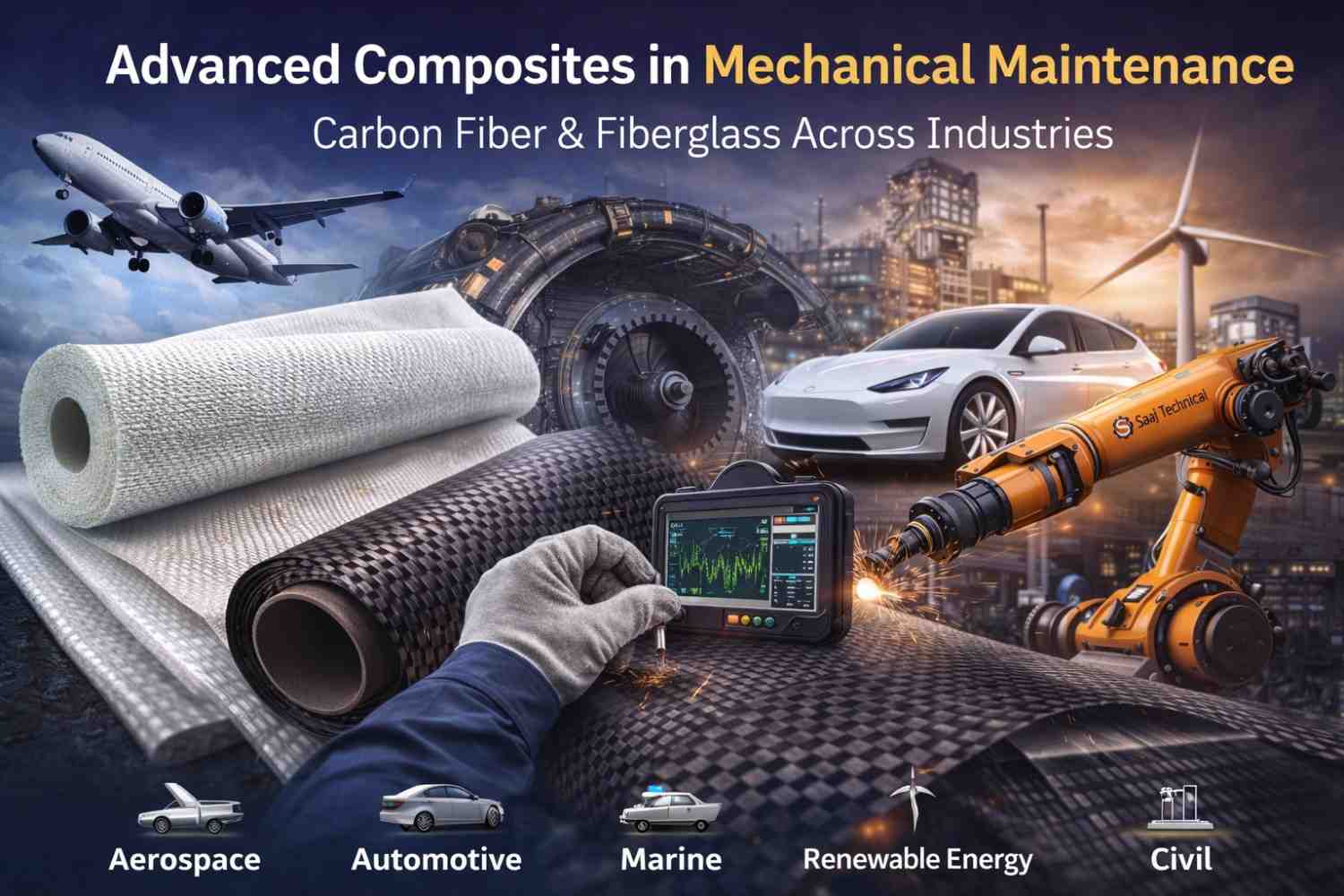
🔹 Applications Across Industries
- Aerospace: Carbon fiber fuselages, wing panels, interiors.
- Automotive: Carbon monocoques, fiberglass body panels.
- Marine: Fiberglass hulls, carbon masts, racing foils.
- Renewable Energy: Resin-infused blades for wind turbines.
- Civil Engineering: FRP wraps for bridges, corrosion-resistant rebar.
🔹 Recent Advancements
- Nanocomposites & Graphene: Enhanced toughness, conductivity.
- Self-Healing Resins: Extend service life.
- Smart Composites: Embedded sensors for structural health monitoring.
- Hybrid Laminates: Glass/carbon hybrids for cost-performance balance.
🔹 Conclusion
Advanced composites are lighter, stronger, and longer-lasting systems that redefine modern engineering. With ABARIS certification, RAAi training, and 18 years of expertise, I’ve seen how fiberglass and carbon fiber enable industries to build smarter, safer, and more sustainable structures.
✅ Engineer’s Checklist
- [ ] Select correct fiber, resin, and core.
- [ ] Validate process (vacuum, cure, resin chemistry).
- [ ] Perform NDT before and after repair.
- [ ] Document parameters for traceability.
- [ ] Train crews in ABARIS/RAAi-certified practices.
📊 Suggested Visuals (for infographic/website)
- Comparison chart: Fiberglass vs. Carbon Fiber (strength, cost, applications).
- Process flow diagram: Resin infusion steps (layup → infusion → cure).
- NDT methods infographic: Ultrasound, thermography, shearography.
- Industry applications map: Aerospace, automotive, marine, energy, civil.